Yang Fu, Xiaoqiang Bai, Zhuoxin Ge, Zhuqing Wan, Mo Zhai, Mingchu Zhao, Dongdong Huang, Xiaodong Guo, Qian Ding, Huaping Xu*, Yongsheng Zhou*, Longwei Lv*.
Adv. Funct. Mater. 2026: e74749.
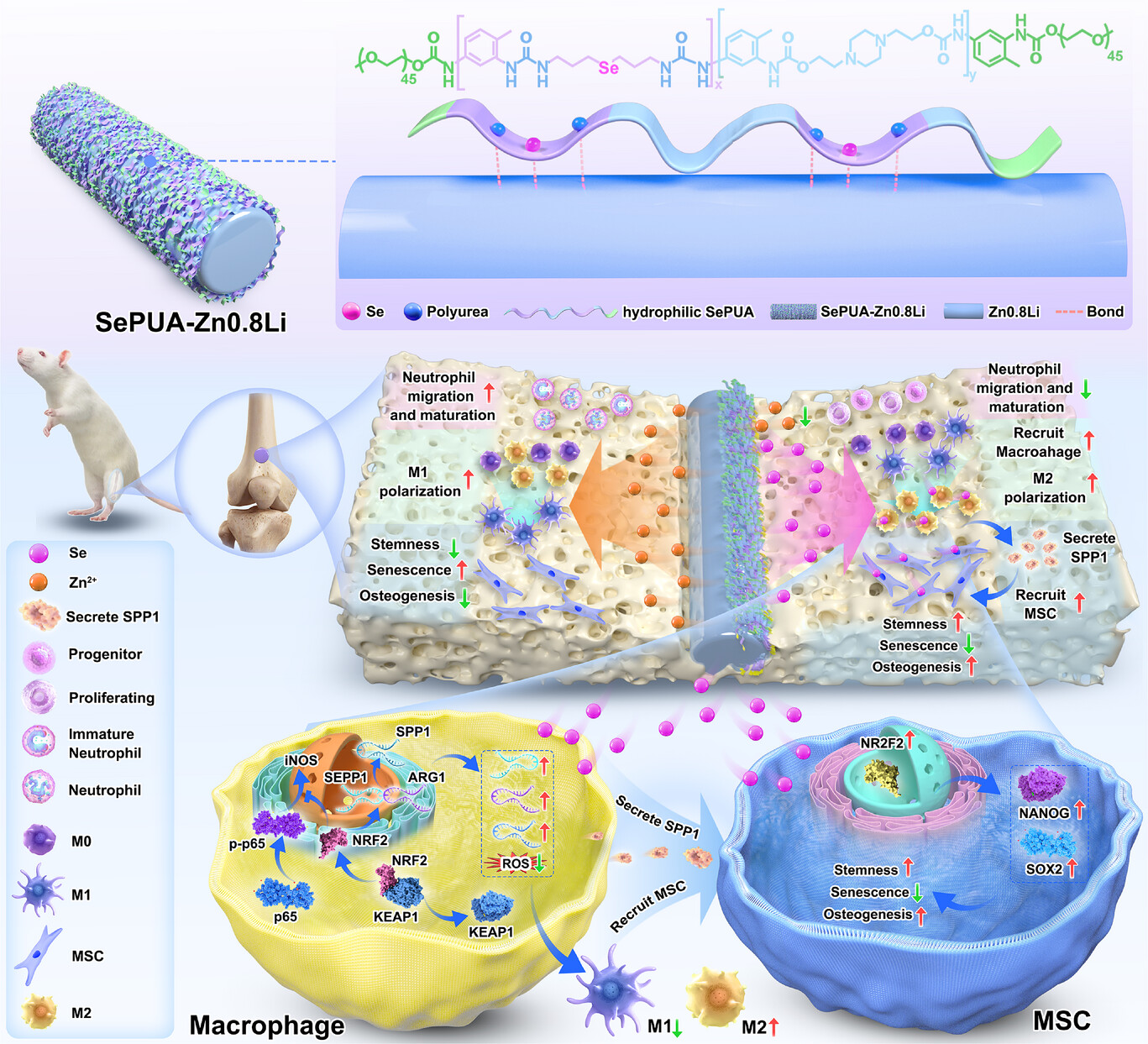
Early burst ion release of biodegradable alloys, such as Zn2+, often triggers inflammation and impairs bone formation, which affects the clinical application of biodegradable alloys. Here, a multifunctional hydrophilic selenium-containing polyurea (SePUA) is designed with a tunable ratio of selenium-containing groups to hydrophilic groups. The SePUA can form stable Se-metal coordination, achieving controlled ion release of biodegradable alloys, and simultaneously leverages the biological functions of selenium to realize immuno-osteogenic synergistic modulation. Single-cell RNA sequencing reveals that SePUA accelerates the shift from acute inflammation to a healing-permissive immune environment. It reduces early Zn2+ release and achieves controllable selenium release, thereby suppressing neutrophil chemotaxis and maturation, recruiting macrophages, activating the KEAP1-NRF2-SEPP1 pathway to decrease intracellular reactive oxygen species (ROS) and drive M2 polarization. Simultaneously, SePUA upregulates the stemness-associated NR2F2-SOX2/NANOG axis in MSCs and enhances their osteogenic differentiation capacity, thereby promoting new bone formation around the implants. This work develops a facile, multifunctional bioactive hydrophilic SePUA for the coating of biodegradable alloys that integrates ion release control, immunomodulation, and osteogenesis, offering critical support for the clinical translation of biodegradable alloys.