Jichun Yang*, Yuhan Wang, Kang Wang, Xiaohui Chen, Yilin Liu, Qianqian Wu, Hengyi Chen, Guangchao Qing, Yunqian Fu, Xin Cui, Yao Luo, Sitong Wang. Guoliang Duan. Mingyang Zhang. Yimin Jia. Xinghong Hu, Zhizeng Wang, Xing-Jie Liang*, Huaping Xu*. Yang Luo*.
ACS Nano, 2025, 19, 31183.
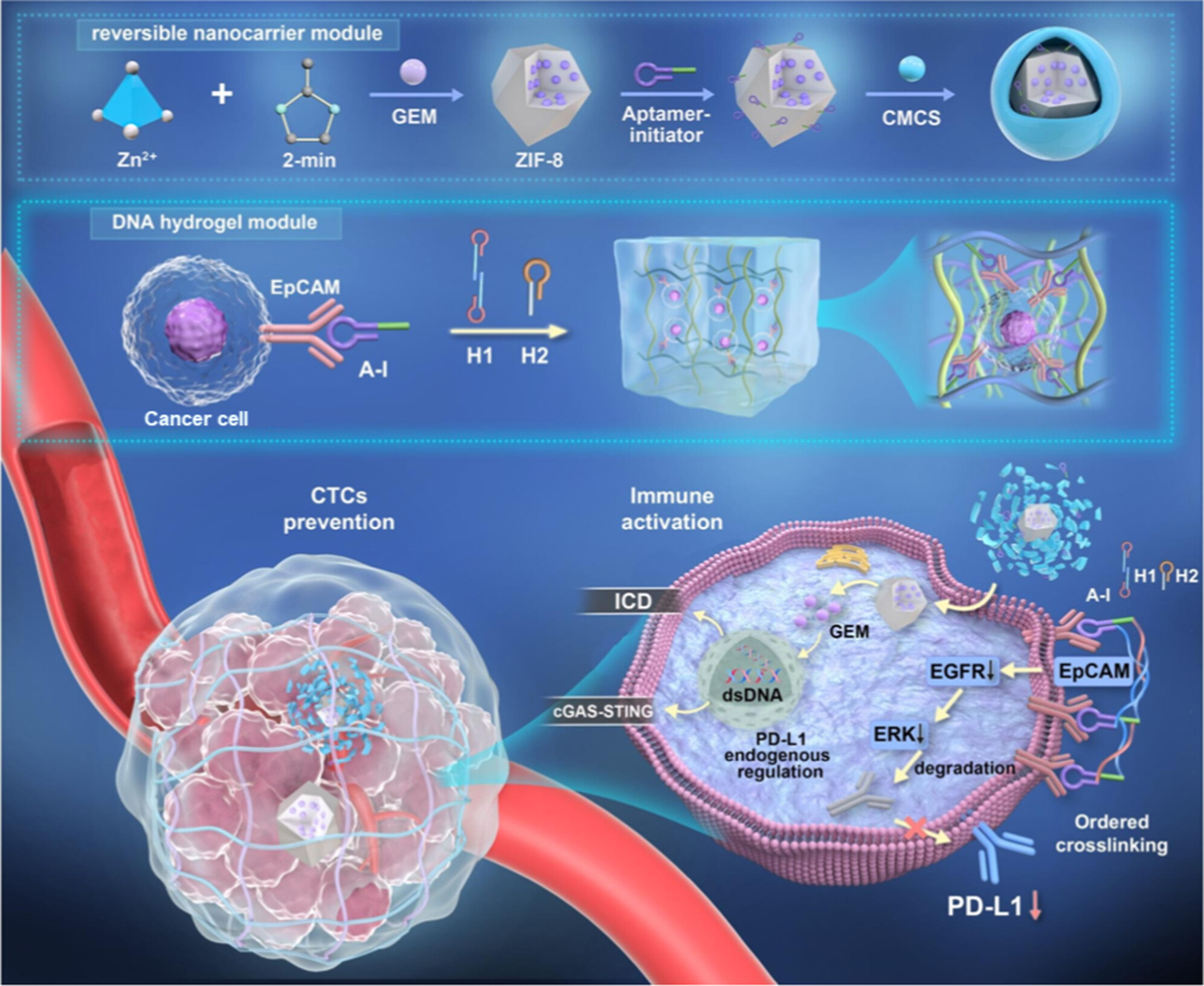
Cancer is one of the most commonly diagnosed diseases with high mortality, and approximately 50% of patients are prone to present metastasis after various treatments. The shedding of circulating tumor cells (CTCs) during tumor therapy is the root cause of metastasis. In this work, we proposed a focused antimetastasis therapy strategy based on a spatiotemporally controllable DNA hydrogel mesh (SNARE: just like a turtle trapped in the jar) in vivo. The whole treatment process was performed in the limited space of the SNARE, which realized the immobilization of CTCs in situ for antimetastasis effects. A stimulus-responsive reversible drug nanocarrier module and an epithelial cell adhesion molecule (EpCAM) aptamer recognition module endowed the SNARE with spatiotemporal controllability for precise tumor cell immobilization. The SNARE also activated a robust immune performance through overcoming immune escape, inducing immunogenic cell death, and enhancing the cGAS-STING pathway to assist the CTC immobilization strategy for a better antimetastasis efficiency. Moreover, it was found that the EpCAM aptamer could realize the endogenous PD-L1 regulation through the epidermal growth factor receptor pathway, and the immunotherapy efficiency was further intensified by the ordered networks of the DNA hydrogel. This work provided a focused antimetastasis therapy strategy for cancer through the immobilization of CTCs in a limited space, which also gave insight into alternative development approaches of immune checkpoint inhibitors.