Chaowei He, Wenjie Zhang, Ruihao Zhou, Zeyu Lu, Zhigang Shuai, Huaping Xu*.
Angew. Chem. Int. Ed.; 2026: e7355159.
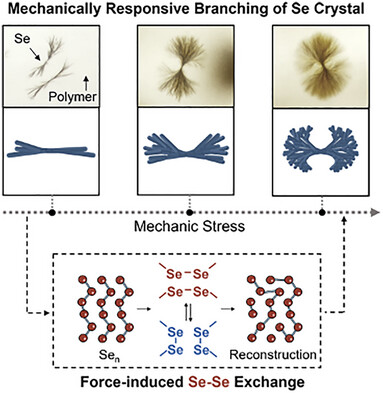
Dynamic covalent chemistry has enabled adaptive behavior in organic polymer networks and molecular crystals, yet analogous control in inorganic crystalline solids remains largely unexplored. Here we show that elemental selenium can operate as a dynamic covalent inorganic crystal, whose architectural and functional adaptability arises from dynamic covalent Se─Se bonds within the trigonal selenium backbone. External mechanical (or optical) stimuli drive Se─Se bond cleavage and reformation, mediating structural reconfiguration of the crystalline framework. Embedding selenium in a crosslinked polymer matrix creates a mechanically programmable environment that exerts real-time and persistent mechanical signals in situ. Under this chemo‑mechanical coupling, crystal branching frequency and three-dimensional architecture respond to matrix stiffness and external light, and these translate directly into tunable dielectric behavior in polymer-selenium composites. This work expands dynamic covalent chemistry from organic to inorganic crystalline materials, and reveals dynamic covalent inorganic crystals as a new class of adaptive materials.