Tiantian Yang, Huaping Xu*.
Acta Polymerica Sinica, 2025, 56, 2302.
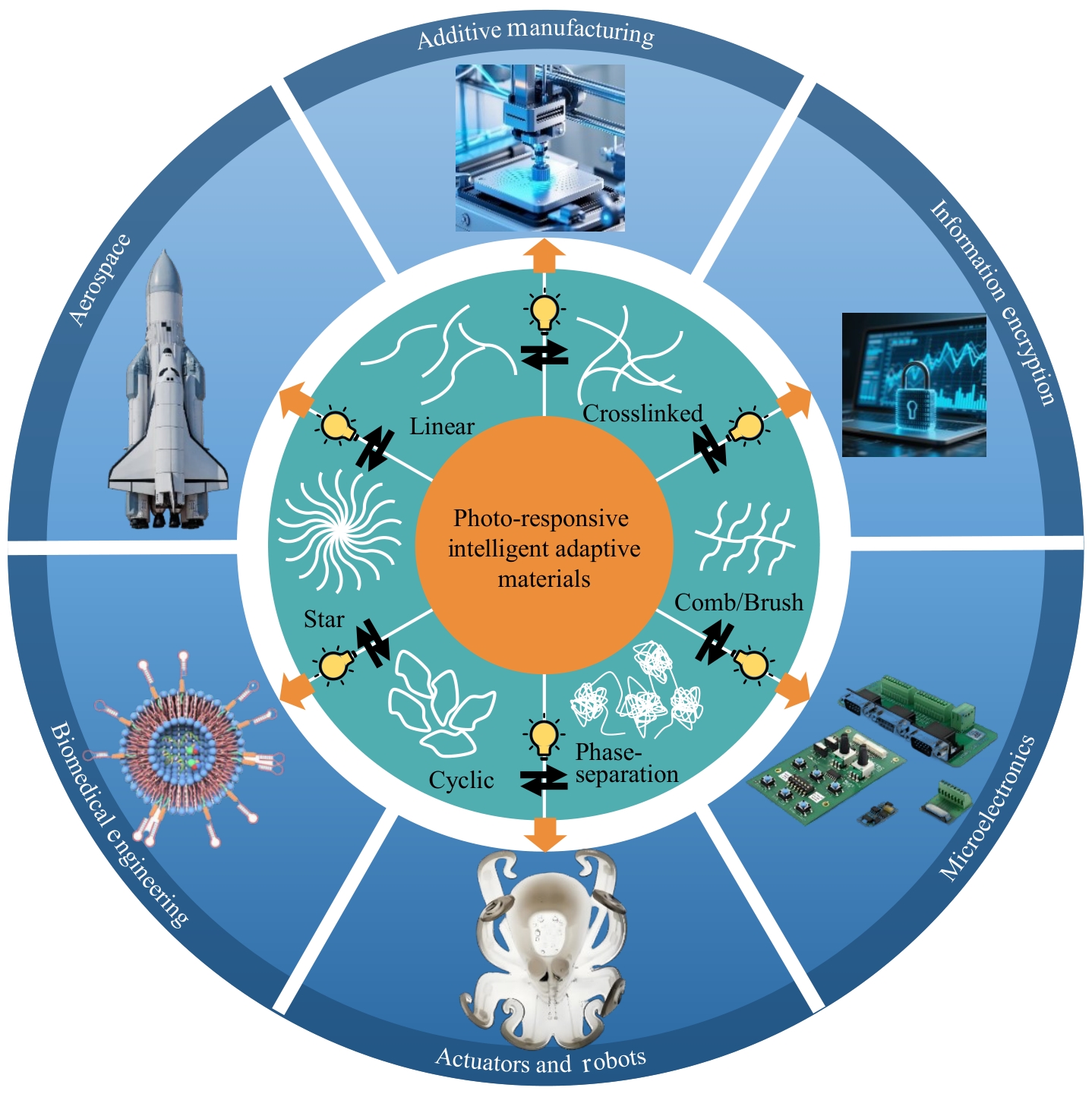
Intelligent adaptive materials constitute a vital component of modern advanced material systems. Compared to other stimuli such as temperature and pH, light exhibit advantageous characters including cleanliness, renewability, and high spatiotemporal resolution. As a result, light-responsive intelligent adaptive materials have witnessed significant development in recent years, both in fundamental research and technological applications. They are now widely applied in frontier fields such as manufacturing, optoelectronics, and bio-nano applications. Polymer topology network, as a decisive factor in material properties, directly influences the material intelligence level through its dynamic reconfiguration capability. This review begins with systematically summarizing the photochemical/physical reaction mechanisms of commonly used photosensitive moieties in light-responsive materials. It then focuses on the multi-level response processes involved in light-controlled topological transformations: through analysis of representative cases, the review elucidates the modulation mechanisms of photo-induced behaviours in photosensitive groups (including isomerization, dissociation/recombination) on material topological structures across multiple molecular-scale aspects—including polymer chain segments (e.g., alteration of crosslinking density), network architecture (e.g., three-dimensional topological reconfiguration), network integrity (e.g., chain scission and degradation), and interface engineering. Finally, the review analyzes current bottlenecks in light-controlled topology reconfigurable materials—such as insufficient response rates, low efficiency, and challenges in mitigating phototoxicity and biotoxicity, and envision their applications in fields like adaptive coatings and programmable soft robotics.