
Lingwu Zeng, Yang Li, Tianyu Li, Wei Cao, Yu Yi, Weijia Geng, Zhiwei Sun, and Huaping Xu
Chem. Asian J., 2014, 9, 2295-2302.
We report the preparation of selenium-containing platinum-based anticancer drug EG-Se/Pt. EG-Se/Pt was obtained from the coordination of selenium-containing molecules (EG-Se) with cisplatin (CDDP). The structure of EG-Se/Pt was characterized by 1H and 77Se NMR spectroscopy, XPS, ESI-MS, and MALDI-TOF. In aqueous solution, EG-Se/Pt self-assembles to form spherical aggregates. EG-Se/Pt shows enhanced stability against dilution and high salt concentration compared wit...
More
Author: wanglu
Dynamic Diselenide Bonds: Exchange Reaction Induced by Visible Light without Catalysis.(Hot Paper)
Shaobo Ji, Wei Cao, Ying Yu, and Huaping Xu
Angew. Chem. Int. Ed., 2014, 53, 6781-6785.
Dynamic covalent bonds are extensively employed in dynamic combinatorial chemistry. The metathesis reaction of disulfide bonds is widely used, but requires catalysis or irradiation with ultraviolet (UV) light. It was found that diselenide bonds are dynamic covalent bonds and undergo dynamic exchange reactions under mild conditions for diselenide metathesis. This reaction is induced by irradiation with visible light and stops in the dark. The exchange is assumed to proceed through a radical mechanism, ...
More
Selenium-containing Coordinating Assemblies with Selective Anti-cancer Activity: the Control of Reactive Oxygen Species.
Tianyu Li, Yu Yi and Huaping Xu
Acta Chim. Sinica, 2014, 72, 1079-1084.
Coordinating assemblies was prepared via coordination between selenium-containing molecules and platinum-containing compounds. These assemblies can induce higher concentration of ROS in cancer cells than in normal cells, thus raising selective anti-cancer activity. This work broadens the applications of simple platinum-containing compounds and selenium-containing molecules in the field of cancer treatment, also develops a new route for preparation of selective anti-cancer drugs.
More
Tuning Polymeric Amphiphilicity via Se-N Interactions: towards One-step Double Emulsion for Highly Selective Enzyme Mimics
Xiaopeng Huang, Ruochen Fang, Dingguan Wang, Jian Wang, Huaping Xu, Yapei Wang and Xi Zhang
Small, 2015, 11, 1537-1541.
A selenium-containing small molecule is exploited to controllably tune the polymer amphiphilicity, leading to fabrication of appropriate polymer surfactants through which one-step double emulsions can be obtained in a facile, scalable, surfactant-free approach. After solvent evaporation, these resulting porous microparticles are shown to be the exceptional artificial GPx enzyme mimics.
More
Research Interests
The synthesis and performance exploration of new polymer materials play a crucial role in advancing both fundamental scientific research and engineering applications. In 2010, we first reported the selenium-containing polymers with redox dual responsiveness, significantly contributing to the development of Se-containing polymers. In 2021, we prepared polytelluoxane in cells, an inorganic main-chain polymer composed entirely of VI group elements, for the first time. This discovery of polytelluoxanes bridges the gap between inorganic oxides and organic polymers. Moving forward, we plan to design...
More
Dual Redox Responsive Coassemblies of Diselenide-Containing Block Copolymers and Polymer Lipids
Lu Wang, Wei Cao, Yu Yi, and Huaping Xu
Langmuir, 2014, 30, 5628-5636.
A general approach is reported to fabricate a stimuli responsive system via coassembly of diselenide-containing block copolymers with polymer lipids, which integrates the stimuli-responsiveness of diselenide chemistry and the biocompatibility of polymer lipids. By using dynamic light scattering, transmission electron microscopy, and zeta potential analyzer, coassembly behavior of these two kinds of polymers and responsiveness of coassemblies have been investigated. These coassemblies can exhibit redox-responsiveness i...
More
Wang, L.; Cao, W.; Yi, Y.; Xu, H.*: Dual Redox Responsive Co-assemblies of Diselenide-containing Block Copolymers and Polymer Lipids. Langmuir, 2014, 30, 5628.
Dr. Huaping Xu attended the 6th Sino-German Joint Symposium
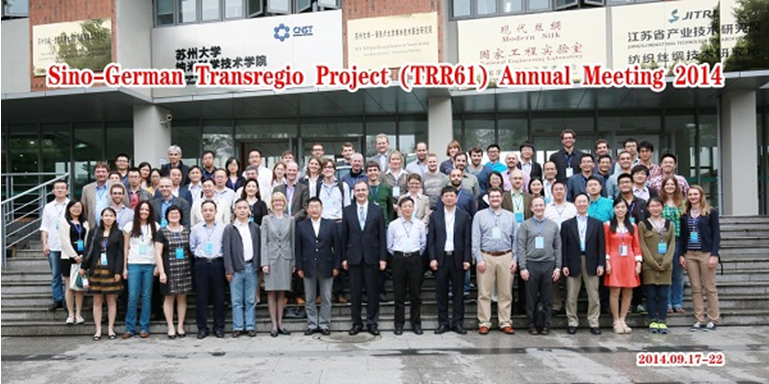
Sep. 18th – 21th 2014, Prof. Xi Zhang, Dr. Huaping Xu and Xinxin Tan, Bin Yuan, Zehuan Huang, Lu Wang attended the 6th Sino-German Joint Symposium on Frontiers of Functional Supramolecular Systems held in Soochow University.
More
news
test news
More